How to Choose the Right Type of Quiz for Your Shopify Store’s Catalog Size

A shopper who can’t decide between twelve nearly-identical products usually doesn’t decide at all – they close the tab. According to McKinsey research, personalization typically lifts revenue by 5-15%, and companies that grow fastest pull 40% more of their revenue from personalization than slower-growing competitors. A quiz for Shopify is one of the simplest ways merchants put that principle into practice. But there’s a catch most stores miss: the quiz only works if its length and logic match how big the catalog actually is.
A three-question quiz on a 400-SKU store will give vague results. A sixteen-question quiz on a 10-SKU store will just frustrate people before they buy anything. This article breaks down how catalog size should shape quiz format, what the data says about completion and conversion, and how two real Shopify stores built quizzes that fit their product range.
Merchants often treat quiz length as a branding decision – short feels modern, long feels thorough. In reality, it’s a math problem. The number of questions a quiz needs is tied directly to how many meaningfully different products exist in the store and how many attributes separate them.
A quiz for Shopify exists to solve decision paralysis. Decision paralysis only shows up when there are enough options to be paralyzing. A boutique with eight hand-poured candles doesn’t have that problem. A supplement brand with sixty SKUs across five categories does.
Three things determine how many questions a quiz actually needs:
Mismatched quizzes tend to fail in one of two predictable ways. On a small catalog, a long quiz adds friction without adding precision – shoppers answer eight questions only to land on the same three products they would have found with two. On a large catalog, a short quiz oversimplifies, recommending a “best guess” instead of the genuinely best match.
Either way, the cost shows up in completion rate before it shows up in sales. Quiz apps for Shopify stores generally report sharp drop-off once a quiz crosses into unnecessary territory, which is the practical reason catalog size needs to come first, before a single question gets written.
If a store sells under 25 products, the honest answer is that customers don’t need much guidance to get to the right one. A short quiz for Shopify – typically three to five questions – usually performs better here than a long one, because the product range is already narrow enough that a handful of filters does the job.
This is where a quiz for Shopify earns its keep fast. Each question should map almost one-to-one with a product attribute that actually changes the recommendation: a wellness goal, a skin concern, a budget range. Anything beyond that starts asking questions for the sake of looking thorough, not for the sake of being accurate.
A working example of this is Semaine Health’s hormone health quiz, built with Visual Quiz Builder. It runs exactly three questions and ends with a tailored supplement recommendation. There’s no padding, no unnecessary branching – just enough information to get the customer to the right product and move them toward checkout.
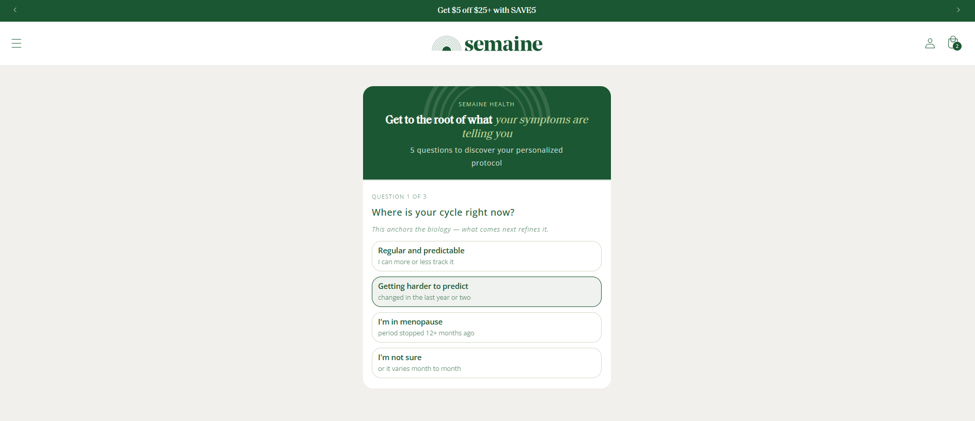
Quick note: A shorter quiz for Shopify isn’t a compromise on a small catalog. It’s the more accurate format, because there’s simply less ground to cover.
Stores carrying somewhere between 25 and 250 products sit in a trickier zone. A three-question quiz won’t separate that many SKUs cleanly, but a sixteen-question quiz risks losing people halfway through.
The fix is a two-layer structure: ask about the broad category first (hair type, room size, fitness goal), then use a second set of questions to narrow within that category. This keeps a quiz app for Shopify stores from feeling like an interview while still giving it enough resolution to recommend something specific.
A few practical habits help at this stage:
There isn’t a universal number, but most data points to the same range. According to industry benchmarking compiled by AdsX, quizzes longer than six questions can see drop-off rates as high as 40% once additional questions stop adding real decision value. Past that point, extra questions tend to test patience rather than improve accuracy.
Stores carrying 250+ SKUs are a different animal entirely. Here, a short quiz genuinely can’t do the job – there are too many product permutations for three or four questions to sort through accurately. This is where a more developed quiz app for Shopify stores, with scoring logic and multi-path branching, becomes necessary rather than optional.
Divi’s hair care quiz is a clear illustration. Built with Visual Quiz Builder, it runs sixteen questions to match shoppers with the right scalp and hair growth treatment from a wide product range. Sixteen questions sounds excessive in isolation, but each one narrows the field of eligible products meaningfully – which is the entire point of a catalog this size.
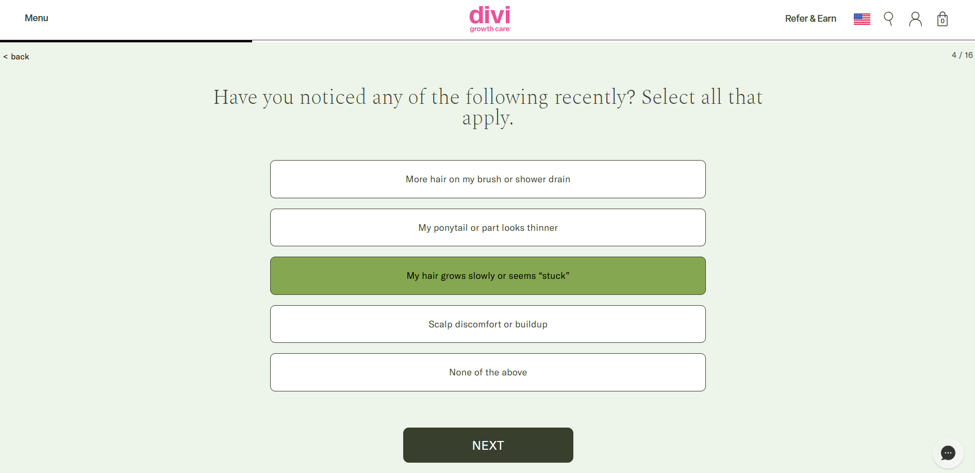
The same sixteen-question structure on a ten-product store would be overkill. On Divi’s catalog, it’s the minimum needed to get an accurate recommendation rather than a generic one.
A few patterns show up again and again across stores of every size, and they’re worth flagging before building anything.
Whatever format gets chosen, the value of a quiz for Shopify shouldn’t end the moment a shopper sees their recommendation. According to McKinsey, personalization most often drives a 10-15% revenue lift, with company-specific results ranging from 5% to 25% depending on sector and execution. That range exists because some brands stop personalizing the moment the quiz ends, and some don’t.
Feeding quiz answers into email flows, on-site retargeting, or future product recommendations keeps that lift compounding well past the first session. A shopper who said they have dry, color-treated hair shouldn’t get a generic newsletter next week – they should get one that speaks to exactly that.
Catalogs rarely stay the same size for long, and a quiz built for fifteen products won’t necessarily make sense once that range grows to a hundred and fifty. It’s worth revisiting the structure of a quiz for Shopify every time the catalog expands meaningfully, rather than letting an outdated short-form quiz try to cover ground it was never built for.
The reverse holds too. A store that trims its catalog down to a tighter, more focused range can usually simplify its quiz without losing any accuracy – fewer products mean fewer questions are needed to land on the right one.
How many questions should a Shopify quiz have?
It depends almost entirely on catalog size. Three to five questions generally suit stores with fewer than 25 products, six to ten work for mid-sized catalogs, and ten-plus questions with branching logic suit catalogs above 250 SKUs.
Does a longer quiz always mean more accurate recommendations?
Not on its own. A longer quiz for Shopify only improves accuracy when the catalog has enough product variation to justify the extra questions. On a small catalog, additional questions usually just increase drop-off without changing the outcome.
What separates a basic quiz from a more advanced quiz app for Shopify stores?
Basic builders handle simple, linear question flows suited to small catalogs. More advanced platforms add scoring systems, conditional branching, and marketing integrations – features that matter more as catalog size and product overlap increase.
Can a quiz be adjusted later without rebuilding it from scratch?
In most cases, yes. Questions and logic can typically be added or removed as the catalog grows or shrinks, which means starting with a simple structure and expanding it later is a reasonable approach.
Where does quiz data go after a shopper finishes it?
Answers usually sync to an email platform or CRM, letting merchants segment shoppers by their specific responses and follow up with messaging that matches what they actually said they needed – rather than treating every customer the same.
Build a professional consulting or corporate website with Alexi. Modern design, responsive layouts, and flexible customization—perfect for business, agency, and service websites.
