Essential Website Design Tips for Businesses in 2026
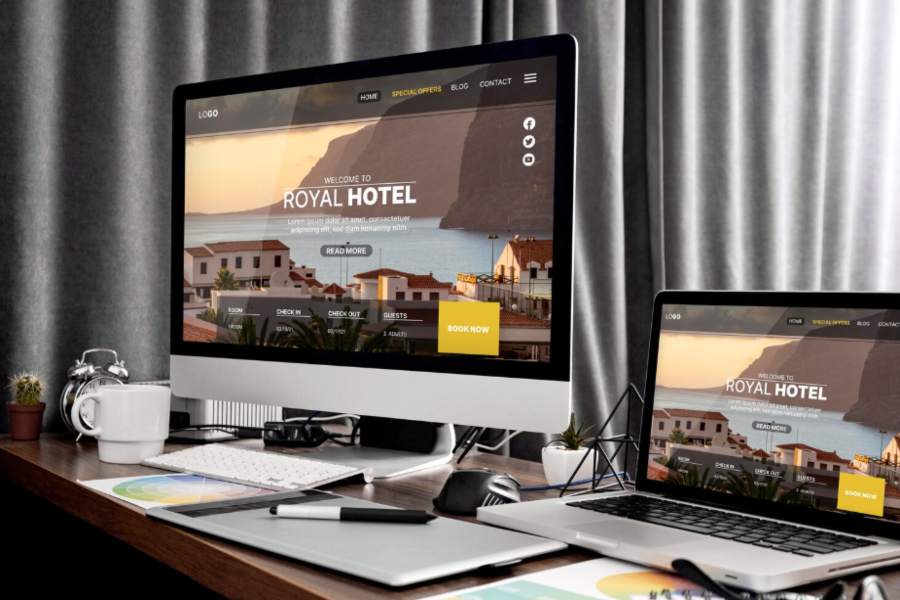
A business website is important for a digital marketing strategy and for online presence. When a website is well designed, it conveys professionalism and authenticity, building trust among customers and stakeholders.
A website design that offers easy-to-find, consistent, and clear information can help a business gain customer loyalty and earn repeat business.
In this article, we will explore some of the best ways to optimize the website design process so that a business can turn visitors into customers.
So, let’s get started!
When planning a website design, focusing on the right elements is important to ensure the final product is effective and engaging. According to our research, the two pillars to consider are clear, actionable goals and a deep understanding of the target audience.
Before designing, the business must define the main purpose of its website. You need to ask yourself if the site is designed to drive sales, generate leads, or offer information.
With clear objectives and goals, the conversion rate can increase and reduce support inquiries. And without clear goals, a website will become a collection of disjointed pages rather than a purposeful strategic tool.
Understanding the target audience is the most important thing since it is about understanding the user, not the brand. Businesses should know who their audience is, what information they like, and what actions they want to take.
Teams can use TextComparely to compare different versions of website copy before publishing.
By keeping in mind these points, you can create a user experience that addresses their needs and makes the website engaging.
User experience and layout are important since they directly impact the visitors’ trust, engagement with the content, and ultimately, it converts visitors into potential customers.
A well-designed website acts as a salesperson that operates around the clock, while a poorly optimized one can lead to abandonment and loss of revenue.
Moreover, businesses need to ensure they have a fast, reliable internet connection when designing their website. This is because it depicts the digital landscape, enables real-time connectivity, data-driven personalization, and seamless access to services across global devices.
For high-speed internet plans, businesses and individuals can reach out to Spectrum Customer Service for fiber-powered connections with speeds in gigabits.
Here are three major reasons why UX and layout are important:
A layout makes it easier for visitors to find information and complete actions like purchasing or signing up. Investing in UX design can offer a return on investment (ROI) of up to 9,900%. Furthermore, a well-designed user interface can increase conversion rates by up to 200%, with better UX driving them up to 400%.
First impressions are 94% design-related, and according to our research, users make a judgment about a website’s credibility within 50 milliseconds, which means a good layout instantly builds trust.
Conversely, 88% of users are less likely to return to a site after a bad UX experience, and 38% will stop engaging if the layout is unattractive.
With increasing mobile traffic, a responsive, well-organized layout is crucial, as user experience rating is determined by how easy a product is to use.
Poorly optimized layouts lead to high abandonment rates, as 53% of mobile users skip a site that takes longer than three seconds to load. For sites that already fall short on those signals, a structured website redesign that revisits information architecture, content hierarchy, and mobile flow can reset the baseline without starting from a blank page.
Design elements are crucial in a website design because they can turn casual visitors into potential customers, which can maximize the ROI for traffic generation.
Nowadays, they are viewed less as a cosmetic choice and more as a powerful data-driven sales tool that can directly influence business growth, trust, and user behavior.
Three main aspects of design elements are important for turning visitors into customers because they establish credibility and improve user experience. Such as:
Clear CTAs are important because they guide visitors on what to do next. They reduce confusion and lower bounce rates.
Without a clear directive, users are likely to leave without taking action, which misses opportunities for conversion. According to our research, personalized CTAs can convert 202% better than generic ones, and adding a single, clear CTA to blog posts can increase conversions by over 120%.
High-quality images are the most important aspect for establishing brand trust and professionalism instantly. They create a faster emotional connection than text. For businesses without a design team, an AI image generator makes it easy to produce polished, on-brand visuals without relying on generic stock photos.
In 2026, visuals are essential for capturing attention in a crowded digital landscape, and poor-quality images actively drive users away. According to a recent survey, pages with high-quality visuals perform 80% better than text-only ones, and 62% of users say poor-quality images reduce trust instantly.
Modern trends, including dark mode, are important because they enhance user comfort, reduce eye strain, and depict a professional, up-to-date brand image. Dark mode is specifically preferred in low-light environments, which improves engagement for longer periods.
Furthermore, dark mode can increase user retention by 27% and night-time session duration by 34%, with 80% of users preferring it in low-light environments.
Trust and credibility are crucial in web design because they directly influence a visitor’s decision to stay, engage, and convert into a customer. A well-designed, professional-looking site builds immediate confidence, whereas a poor design can make users distrust a site, which can destroy a brand’s reputation.
There are three main things that a person needs to consider while designing a website to build trust and credibility, such as:
Social proof is important since, according to ProveSource, 92% of consumers hesitate to purchase when reviews are missing, and 72% trust customer reviews more than brand product descriptions.
Think of it as a psychological phenomenon where people copy the actions of others before making any decision. According to research, user-generated photos can increase conversion rate by 29%.
However, a lack of validation can lead to high abandonment rates, as 54% of people avoid buying products entirely if no reviews exist.
Contact information acts as a vital signal of legitimacy, which reduces anxiety in potential customers who need assurance that a real entity exists behind the screen.
Research indicates that 44% of website visitors will leave a company’s website if there is no contact information or phone number present.
Apart from this, having a clearly visible Contact Us link or page enhances credibility and acts as a trust-building element.
Secure browsing like HTTPS is no longer optional but a requirement for trust and functionality, as 90% of websites globally now use HTTPS.
Apart from this, HTTPS is a critical SEO factor as Google flags HTTP sites as they are not secure, which leads to lower search rankings and significant traffic loss.
In 2026, a modern website is no longer optional, but it is your business’s most powerful salesperson.
By focusing on mobile-first design, AI-driven personalization, and fast speeds, you can ensure that your brand stays ahead of the competition.
Don’t waste your time, update your site today, and turn visitors into loyal customers.
Build a professional consulting or corporate website with Alexi. Modern design, responsive layouts, and flexible customization—perfect for business, agency, and service websites.
