How to Scale Social Media Marketing using Cloud Phones
Social media marketing has an infrastructure problem that most teams quietly work around rather than fix. Strategy conversations never slow down: editorial calendars, funnel optimization, paid media, audience targeting, scheduling tools. Campaigns can even span niche industries, from ecommerce brands to legal services like TikStoryAmerica. But the operational layer holding all of that together gets overlooked until something breaks.
Remote work made things harder. Campaigns get planned in one country, run in another, and reviewed by someone in a third time zone. That flexibility has real value. But the platforms your team uses every day, like Instagram, TikTok, Facebook and Reddit, were never designed with distributed teams in mind. They were built on one assumption: one person, one device, one location.
When that breaks down at scale, problems show up gradually, then all at once.
This article covers what happens behind the scenes when remote social media marketing teams hit platform friction, and how Multilogin cloud phones have become the infrastructure fix that agencies and multi-market teams are folding into their operations.
Most friction that teams blame on strategy or content quality is actually an identity problem.
Every time someone accesses a client account from a different device, browser, or IP address, the platform logs that shift. It doesn’t know your team grew or that you brought on someone new. It just sees an account that used to behave one way now behaving differently, and responds accordingly. Sometimes it’s a security check. Other times it’s a quiet reach drop or an ad account restriction landing right in the middle of a campaign.
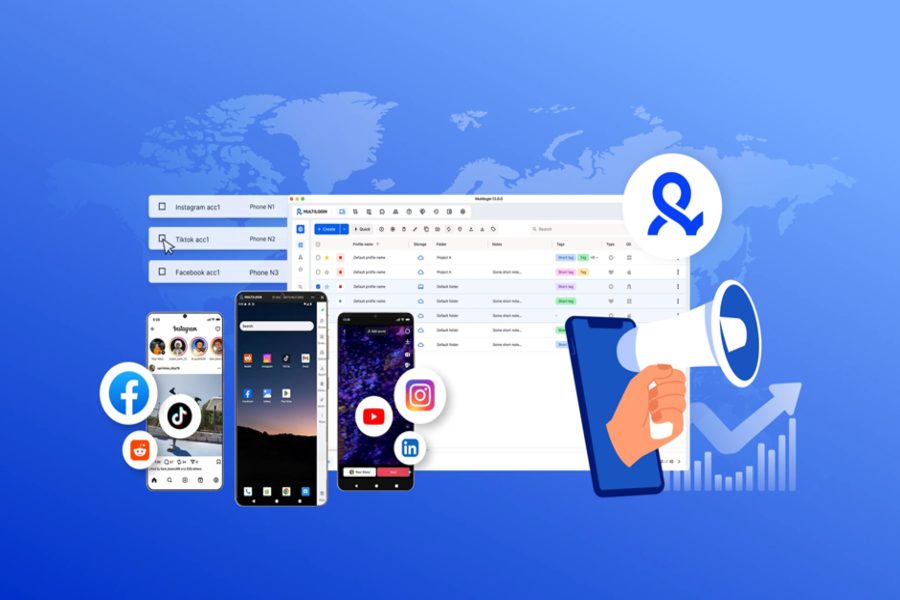
Solution: Multilogin is a cloud Android phone platform for multi-account management. Each Multilogin cloud phone is a real Android device hosted in the cloud, not an emulator, with its own app data, location and IP that stay the same across sessions with its own app data, location and IP. App data and login history stay on the device between sessions.. Assign one to a client account, and that account is always opened from the same device and location.
Platforms distribute content based on where an account lives, not where the person managing it happens to be sitting. Teams increasingly rely on AI for social media to analyze regional trends, predict engagement patterns, and optimize posting strategies, but those insights still depend on seeing what real local users actually experience on each platform.
Trending audio on TikTok in Brazil looks nothing like what’s trending in Germany. Instagram’s Explore feed in Japan surfaces completely different content than in the US. What drives engagement in one market doesn’t carry over automatically to another. When a remote team doing social media management across multiple countries works from a single location, they can read data on trends but they can’t see what a real local user actually sees when they open the app. You can also track monetization insights, such as Instagram Pay Per View, to understand how local engagement translates to earnings.
Solution: Each Multilogin cloud phone gets its own IP matched to the country or city you choose. Open TikTok on a cloud phone with a Brazilian IP and you see the local trending audio, recommendations, and ad formats that location receives.
Most social media management platforms separate clients at the interface level: different dashboards, different credentials. Useful for staying organized, but it doesn’t fix what happens at the device level. When multiple client accounts are accessed from the same device and browser profile, the platform still sees them as linked. Cookies bleed across sessions. Behavioral signals overlap.
For agencies running mobile marketing campaigns across several brands, including a FStoryAmerica campaign, this means one account’s problems can affect another’s standing simply because they share the same environment.
Solution: Each Multilogin cloud phone has its own installed apps, app data, and login sessions, so client accounts don’t share anything. Ten clients means ten separate environments, not ten tabs open in the same browser.
Remote work created a credential-sharing problem nobody built a clean solution for. Logins for social media marketing accounts end up scattered across spreadsheets, shared notes, and old group chats. The default workaround is sharing passwords and hoping nobody triggers a suspicious login alert.
This risk grows when teams handle sensitive client accounts, such as a InStory America campaign.
Solution: Multilogin handles team access through role-based permissions. Each team member gets access to exactly the environments they need, with permissions that match their role. Team seats and permissions let you share and assign environments, and each client account keeps its own device and location.
The typical response to growth is buying more devices. Another phone per client, another SIM per market, another shelf of hardware to charge, update, and manage when someone leaves. It holds up at small scale and falls apart exactly when you need it most.
Teams that need to manage multiple social media accounts across platforms don’t need a multitude of independent tools. A central dashboard ensures smooth workflows and can be easily combined with a URL-shortener to efficiently manage campaign links and measure their performance. At the same time, separating tasks by environment—Reddit and X in a web browser, Instagram and TikTok on mobile devices—ensures that each user works in the right context without having to juggle separate systems. Platforms and tools like Tikiewer can simplify content review and account insights, helping teams scale faster without adding unnecessary complexity.
Solution: Adding a new client means spinning up a new isolated environment with the right location, device model, and proxy configuration in place. Multilogin offers 30+ real Android device types across 12 brands, including Samsung, Xiaomi, Google, Motorola, OPPO, and Vivo, with multiple Android versions selectable per profile. Mobile minutes are included in every plan, extra minutes can be bought as add-ons, and unused purchased minutes roll over, which matters for agencies with seasonal campaigns. Multilogin offers a free plan with no time limit and no credit card needed. Paid plans start from $7.67 per month (billed annually) or $11 billed monthly.
Social media management already runs across multiple markets, devices, and time zones simultaneously. The platforms still expect consistency: stable device identity, local signals, predictable behavior from each account. Teams without that foundation feel the cost over time, with quiet reach drops, mid-campaign restrictions, account lockouts that take days to clear.
For agencies and remote teams doing social media marketing across multiple markets, the cloud phone closes that gap with isolated environments, built-in proxies, and team access controls — all in one place. It’s not a workaround. It’s how the infrastructure should have been set up from the start.
Build a professional consulting or corporate website with Alexi. Modern design, responsive layouts, and flexible customization—perfect for business, agency, and service websites.
