How to Scale Social Media Marketing using Cloud Phones
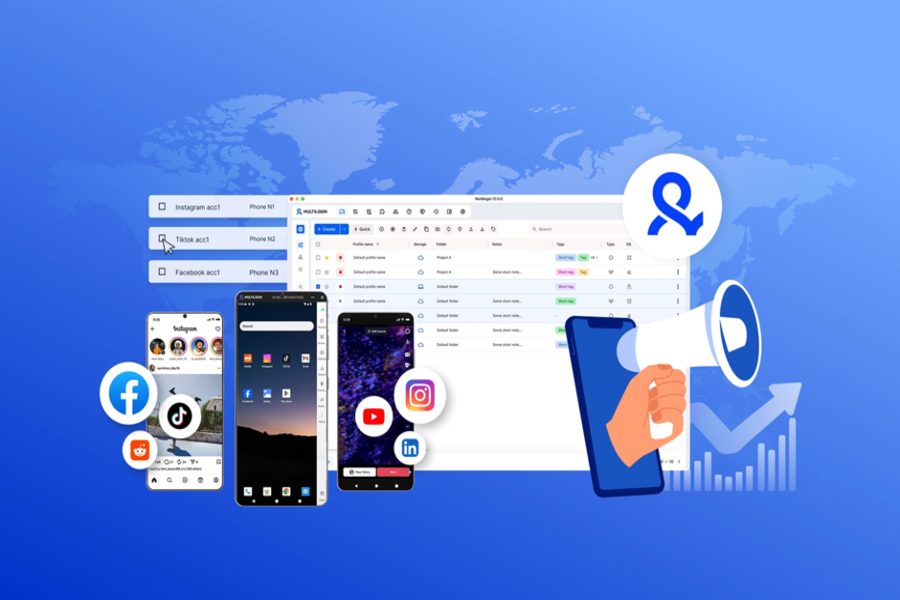
Social media marketing has an infrastructure problem that most teams quietly work around rather than fix. Strategy conversations never slow down: editorial calendars, funnel optimization, paid media, audience targeting, scheduling tools. Campaigns can even span niche industries, from ecommerce brands to legal services like TikStoryAmerica. But the operational layer holding all of that together gets overlooked until something breaks.
Remote work made things harder. Campaigns get planned in one country, run in another, and reviewed by someone in a third time zone. That flexibility has real value. But the platforms your team uses every day, like Instagram, TikTok, Facebook and Reddit, were never designed with distributed teams in mind. They were built on one assumption: one person, one device, one location.
When that breaks down at scale, problems show up gradually, then all at once.
This article covers what happens behind the scenes when remote social media marketing teams hit platform friction, and how Multilogin’s cloud phones have become the infrastructure fix that agencies and multi-market teams are folding into their operations.
Most friction that teams blame on strategy or content quality is actually an identity problem.
Every time someone accesses a client account from a different device, browser, or IP address, the platform logs that shift. It doesn’t know your team grew or that you brought on someone new. It just sees an account that used to behave one way now behaving differently, and responds accordingly. Sometimes it’s a security check. Other times it’s a quiet reach drop or an ad account restriction landing right in the middle of a campaign.
Solution: Multilogin’s cloud phone is a real Android device hosted in the cloud — not an emulator. Physical hardware with real device identifiers that stay consistent across every session. Assign one to a client account, and that account always looks like the same smartphone, logging in from the same location. To Instagram or TikTok, nothing unusual is happening.
Platforms distribute content based on where an account lives, not where the person managing it happens to be sitting. Teams increasingly rely on AI for social media to analyze regional trends, predict engagement patterns, and optimize posting strategies, but those insights still depend on seeing what real local users actually experience on each platform.
Trending audio on TikTok in Brazil looks nothing like what’s trending in Germany. Instagram’s Explore feed in Japan surfaces completely different content than in the US. What drives engagement in one market doesn’t carry over automatically to another. When a remote team doing social media management across multiple countries works from a single location, they can read data on trends but they can’t see what a real local user actually sees when they open the app. You can also track monetization insights, such as Instagram Pay Per View, to understand how local engagement translates to earnings.
Solution: Each Multilogin cloud phone carries its own residential/mobile IP tied to a specific country or city of your choice. Open TikTok on a cloud phone with a Brazilian IP and you see what a Brazilian user sees local trending audio, local recommendations, local ad formats. A scheduling tool tells the platform when to post. A cloud phone tells it where the account lives. Both matter, but only one directly affects who sees the content.
Most social media management platforms separate clients at the interface level: different dashboards, different credentials. Useful for staying organized, but it doesn’t fix what happens at the device level. When multiple client accounts are accessed from the same device and browser profile, the platform still sees them as linked. Cookies bleed across sessions. Behavioral signals overlap.
For agencies running mobile marketing campaigns across several brands, including a FStoryAmerica campaign, this means one account’s problems can affect another’s standing simply because they share the same environment.
Solution: Multilogin cloud phones are isolated at the hardware level. Each has its own installed apps, login sessions, browsing history, and cache. A restriction on one client account leaves no trace on another. Ten clients means ten genuinely independent environments, not ten tabs open in the same browser.
Remote work created a credential-sharing problem nobody built a clean solution for. Logins for social media marketing accounts end up scattered across spreadsheets, shared notes, and old group chats. The default workaround is sharing passwords and hoping nobody triggers a suspicious login alert.
This risk grows when teams handle sensitive client accounts, such as a InStory America campaign.
Solution: Multilogin handles team access through role-based permissions. Each team member gets access to exactly the environments they need, with permissions that match their role. No shared passwords, no personal device logins accidentally flagging the platform. The client account keeps a consistent identity. The team keeps clean, auditable access. Credentials stay where they belong.
The typical response to growth is buying more devices. Another phone per client, another SIM per market, another shelf of hardware to charge, update, and manage when someone leaves. It holds up at small scale and falls apart exactly when you need it most.
Teams that need to manage multiple social media accounts across platforms don’t need a multitude of independent tools. A central dashboard ensures smooth workflows and can be easily combined with a URL-shortener to efficiently manage campaign links and measure their performance. At the same time, separating tasks by environment—Reddit and X in a web browser, Instagram and TikTok on mobile devices—ensures that each user works in the right context without having to juggle separate systems. Platforms and tools like Tikiewer can simplify content review and account insights, helping teams scale faster without adding unnecessary complexity.
Solution: Adding a new client means spinning up a new isolated environment with the right location, device model, and proxy configuration in place. Multilogin offers around 30 device models from brands including Samsung, Xiaomi, Motorola, OnePlus, OPPO, and Vivo, running Android 10 through 15.
Pricing is per minute of use, with unused minutes rolling over to the next month, which matters for agencies with seasonal campaigns or clients at different activity levels.The platform is also becoming more accessible with a new pricing update on May 20, when prices will be converted to USD. You’ll be able to test the full platform with a $2 trial that includes access to all features. Plans start at $7.08/month (billed annually)
Social media management already runs across multiple markets, devices, and time zones simultaneously. The platforms still expect consistency: stable device identity, local signals, predictable behavior from each account. Teams without that foundation feel the cost over time, with quiet reach drops, mid-campaign restrictions, account lockouts that take days to clear.
For agencies and remote teams doing social media marketing across multiple markets, the cloud phone closes that gap with isolated environments, built-in proxies, and team access controls — all in one place. It’s not a workaround. It’s how the infrastructure should have been set up from the start.
Build a professional consulting or corporate website with Alexi. Modern design, responsive layouts, and flexible customization—perfect for business, agency, and service websites.
